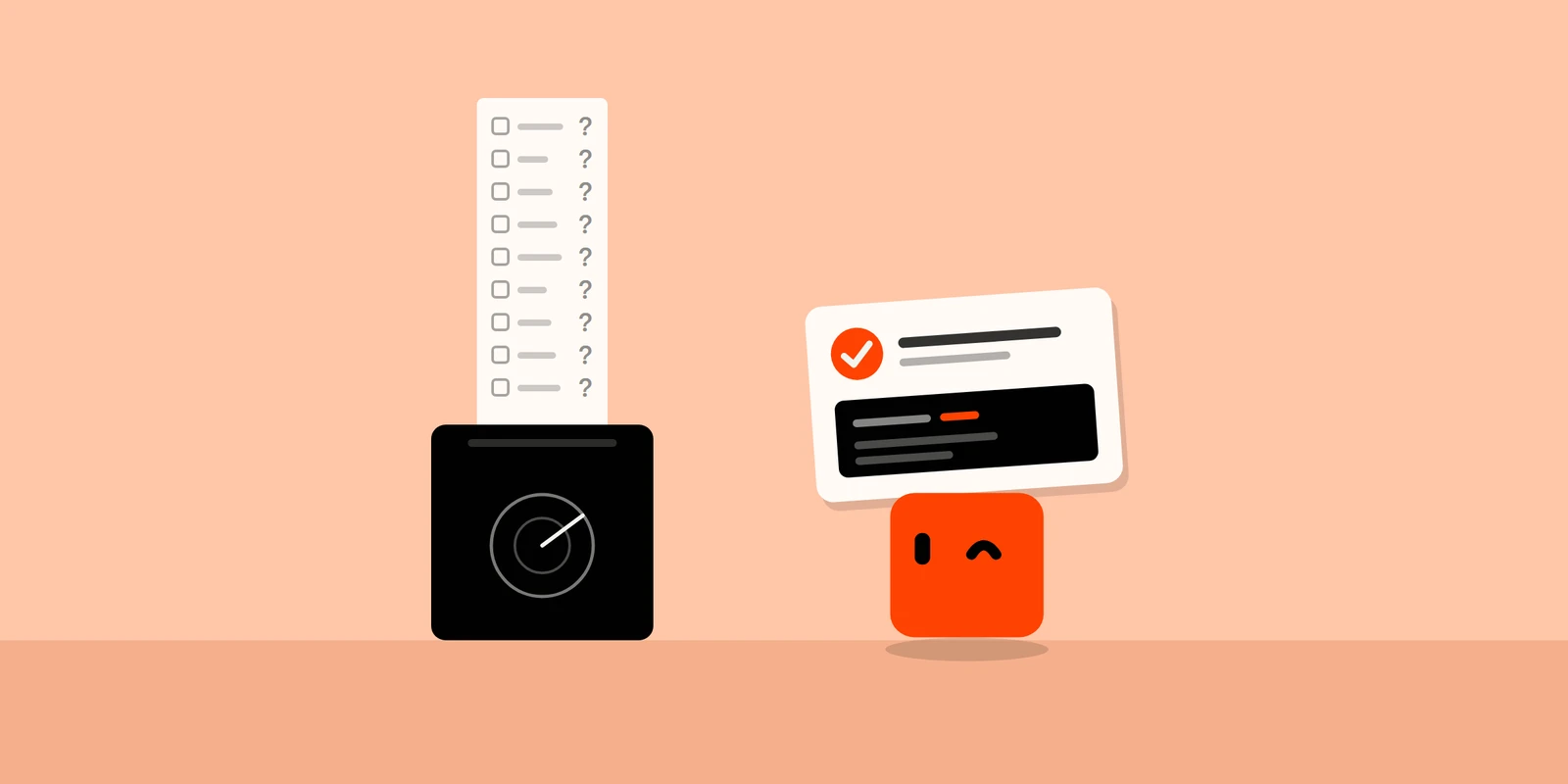
AI penetration testing is a penetration test carried out by an AI agent instead of a person working by hand. The agent is given an authorized target, such as a web app, an API or a code repository. It explores it, forms hypotheses about what could break, tries real attacks, and keeps only the findings it can prove. A good AI pentest ends the way a good human one does: with reproducible evidence of what an attacker could actually do.
The difference is not the standard of proof. It is the cost and frequency of reaching it. A human engagement is usually booked once or twice a year. An agent can run the same kind of investigation every week, or on every release.
"AI penetration testing" means two different things
Search for the term and you will find two unrelated subjects under one name.
- Pentesting done by AI. An AI agent attacks a normal application, the subject of this article.
- Pentesting of AI. A tester, human or not, attacks an AI system: prompt injection, model abuse, data leaking through a chatbot.
Both are real disciplines, and they need different skills and tools. When you evaluate a vendor, check which one it sells. Vulnix does the first: an AI agent that tests web apps, APIs and code.
What is penetration testing, in one paragraph?
A penetration test is an authorized, simulated attack that tries to reach a real security impact, such as reading another customer's data or taking over an account, and documents how. NIST's guide to security testing (SP 800-115) treats it as a separate technique from vulnerability scanning: the assessor mimics real-world attacks to find ways around the security controls, instead of listing conditions that might be weak. The output that matters is the attack path, not a list of warnings.
How does an AI pentest work?
An autonomous pentest follows the same stages a human tester would. What changes is who runs the loop between them.
- Scope and authorization. The agent may only touch targets you own and have authorized. In Vulnix, that means a domain you verified (by DNS record, file or meta tag) or a repository you connected, plus scope rules and an optional testing window.
- Reconnaissance. The agent maps what is actually exposed: hosts, services, endpoints, parameters, and the way the application behaves when signed in as a test user.
- Hypotheses and attempts. It reads responses, guesses where a control might be weak, and tries the requests that would prove it. When an attempt fails, it changes the hypothesis, the way a person would.
- Proof. A finding is kept only if the attack worked: the request, the response and the observed impact. Everything else is discarded instead of reported as "potential".
- Report. Each finding comes with severity, evidence, reproduction steps and remediation advice, plus a trace of what the agent tried along the way.
- Retest. After a fix ships, the same exploit is replayed against the deployed app to confirm the attack no longer lands.
Steps 3 and 4 are where AI changed the economics. Running tools was automated years ago. Deciding what to try next, from what the application just said, was the part that needed a person.
What can AI pentesting find, and where does it struggle?
Agents are strongest where a vulnerability can be demonstrated with a clear request and a clear result, and weakest where the answer depends on business context no one wrote down.
| Area | How agents do | Why |
|---|---|---|
| Injection, SSRF, exposed data | Strong | The attack and the impact are both observable in responses. |
| Broken access control and IDOR | Good, with test accounts | Proof means showing one user reaching another user's data. |
| Multi-step chains | Improving | Each step is simple; keeping context across many steps is the hard part. |
| Business-logic abuse | Limited | "Should this discount stack?" is a policy question, not a technical one. |
| Social engineering, physical access | Out of scope | Not part of an application test. |
The research matches this picture. The PentestGPT study (USENIX Security 2024) found that language models handle individual pentesting sub-tasks well, such as using tools and interpreting their output, but struggle to keep an integrated view of the whole test. Products in this category are largely engineering answers to that problem: memory, planning, and strict evidence rules around the model.
There is also public evidence that the approach works on real targets. In 2025 the autonomous system XBOW reached the top of HackerOne's US bug bounty leaderboard, with its reports reviewed by people before submission, as the platform's rules required.
AI pentest vs. vulnerability scan vs. manual pentest
| Vulnerability scan | AI pentest | Manual pentest | |
|---|---|---|---|
| What it answers | "What looks vulnerable?" | "What can an attacker actually do?" | "What can an attacker actually do?" |
| Proof per finding | Rarely | Yes, a working exploit | Yes, a working exploit |
| How often | Continuously | Every week or release | Once or twice a year |
| Business context | None | Limited | Strong |
| Cost per run | Lowest | Low | Highest |
They are not substitutes. Scanners stay the right tool for broad, mechanical coverage, such as every dependency and every exposed service. A human test is still worth it for high-stakes, logic-heavy systems. The AI pentest fills the long gap between them, when the app changes every week but nobody attacks it until the next annual test. We wrote more about that handoff in AI penetration testing vs. vulnerability scanning.
Is AI penetration testing safe to run?
It should be, and you can check how. An agent that improvises attacks needs firmer guardrails than a scanner that runs a fixed list.
- Only authorized targets. Testing should start only after you prove you control the target, not after someone types a URL into a chat.
- Isolation. The agent should run in its own sandbox, separate from other customers' runs.
- A full trace. Every action the agent took should be recorded, so you can see exactly what touched your systems.
- Credentials handled carefully. Test-user passwords should be encrypted at rest and only available inside the run that needs them.
Vulnix runs each test in an isolated sandbox against verified targets only, and keeps the agent's trace with every run. The details are in Security & Trust.
How do you evaluate an AI pentesting tool?
Ask for one finding, not the feature list, and check whether it holds up.
- Is there a working exploit? A finding should show the request, the response and the impact, not a confidence score.
- Can you reproduce it? The steps should work for an engineer who was not there.
- What did it not test? Honest tools state their limits and their scope.
- How are false positives handled? "We filter them" is not an answer; "we only report what we exploited" is.
- Can it test as a signed-in user? Most serious bugs live behind the login.
- Can it check a fix? The value of a finding ends when you know it is closed.
- Is the agent's work visible? A trace of what it tried is how you trust, and audit, an autonomous tester.
Where Vulnix fits
Vulnix is an AI penetration testing platform built around that standard of proof. It runs blackbox tests against live web apps and APIs, and whitebox tests against connected GitHub repositories. A finding is reported only with a working exploit and the evidence to reproduce it. After a fix, Validate-Fix replays the original exploit against the patched app. Reports export as PDF, DOCX, JSON or SARIF, and the same engine can review every pull request before it merges.
It does not replace every kind of test. It makes the attacker's view of your app something you can have every week, with evidence an engineer can act on. You can see how it works on vulnix.dev, or read about blackbox and whitebox testing.
Frequently asked questions
Is AI penetration testing the same as an automated vulnerability scan?
No. A scanner runs fixed checks and reports what might be vulnerable. An AI pentest decides what to try next from the application's responses, attempts real exploits, and reports only what it could prove. Scanners give coverage; pentests give proof.
Can AI penetration testing replace human pentesters?
Not entirely. Agents now handle much of the repeatable work, and they can test far more often than a human engagement allows. People are still better at business logic, unusual architectures and judging which risks matter most to a specific company. Many teams run AI pentests continuously and keep a human test for their highest-risk systems.
What is the difference between AI pentesting and pentesting AI?
AI pentesting uses an AI agent to attack ordinary applications. Pentesting AI means attacking an AI system itself, for example with prompt injection or attempts to extract training data. They are different services with different tools.
Is it safe to let an AI agent attack my application?
It is safe when the platform enforces scope and isolation: testing only targets you have verified, running in a sandbox, encrypting test credentials, and recording every action. Ask any vendor how each of those works before you start.
How often should you run an AI pentest?
As often as the application changes in ways that matter: weekly for a fast-moving product, and after significant releases at minimum. The point of automation is that testing no longer has to wait for the annual engagement.
Sources
- NIST, SP 800-115: Technical Guide to Information Security Testing and Assessment.
- Deng et al., PentestGPT: Evaluating and Harnessing Large Language Models for Automated Penetration Testing, USENIX Security 2024.
- XBOW's account of reaching the top of HackerOne's US leaderboard, and TechRepublic, AI Bug Hunter Sets Milestone By Claiming Top Spot on HackerOne's Leaderboard.